
The Digital Kit

Digital course · For staff at small US nonprofits under $1M

Nonprofit Grant Proposal System

The reusable proposal system for small nonprofits chasing foundation grants.

See the curriculum

Professional edition $249 · editions from $119

Four linked matte tiles reading INPUTS, ACTIVITIES, OUTPUTS and OUTCOMES, with the OUTCOMES tile in deep green

First output

A funder-ready fact base in 15 minutes

Total time

About 10 to 13 hours, start to submission workflow

You keep

A 12-part reusable proposal pack

Level

No grant experience required

Foundation grants just got crowded.

In a 2025 survey of more than 300 US nonprofit professionals, 82 percent said they are pursuing more private and corporate grants, and only 55 percent felt confident in their funding strategy. More organizations are asking the same foundations for money. Proposal quality is becoming the differentiator.

Source: Instrumentl, New Funding Rush, October 2025, non-probability sample of grant-active nonprofits.

82%

of surveyed nonprofits are pursuing more private and corporate grants

55%

feel confident in their current funding strategy

20×

a single $5,000 award would repay the $249 Professional edition twenty times over

Written for the accidental grant writer.

For program managers, development staff, executive directors and founders at small US nonprofits with budgets under $1 million who became responsible for foundation grants without formal training. You are the person responsible for bringing foundation money into a small organization, without a grants department behind you.

It is not for experienced grant professionals seeking only templates, large development departments, or anyone chasing guaranteed awards.

The transformation

From staff member responsible for grants without training to the operator of a complete, reusable, funder-ready proposal system for one organization.

12 componentsOne packReuse for the next funder
Fig. 01Twelve reusable components, one funder-ready pack. The dashed return is the reuse workflow: the second application starts assembled.

A proposal system, not a single proposal.

Fit and eligibility failures outnumber writing failures. So the course builds twelve reusable components that answer any funder's application, then teaches the compliance and reuse workflow that keeps them current. This is the pack, by workbook page:

  • WB-003Organization fact base
  • WB-005Eligibility matrix
  • WB-006Funder-fit scorecard and shortlist
  • WB-009Needs statement with evidence log
  • WB-011One-page logic model
  • WB-012Program description
  • WB-015Evaluation plan
  • WB-017Program budget
  • WB-018Budget narrative
  • WB-019Reusable core narrative bank
  • WB-020Letter of inquiry
  • WB-023Compliance check and submission record

Plus the 24-page Core Action Workbook, the 12-page Advanced Toolkit, a 2-page field reference, and three fully worked demonstrations.

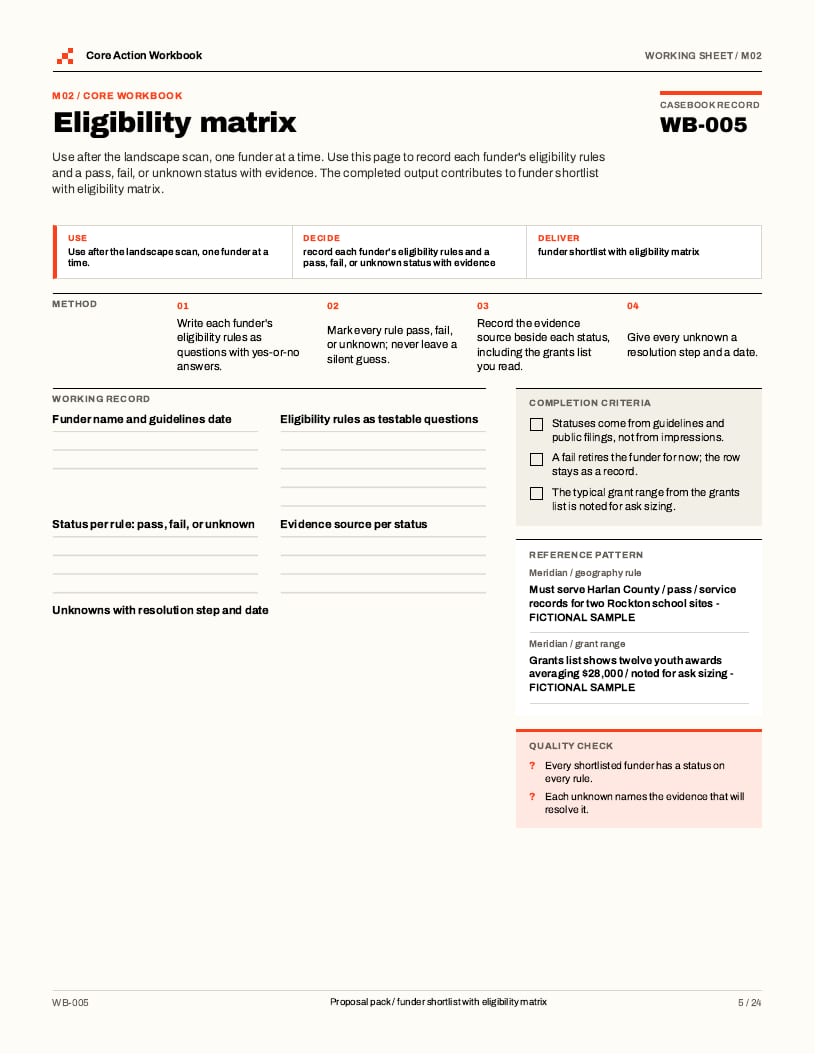
Workbook page WB-005, the eligibility matrix, with method and quality checks
WB-005 as you download it: use, decide, deliver, method, working record and quality check on one page.

Two editions. One method.

Essentials is the course and the workbook. Professional adds every working template, the three worked demonstrations and the presentation edition. Both licence one person.

Essentials

The complete course and workbook.

$119

  • The full 8-module course as a 96-page reader coursebook
  • 24-page Core Action Workbook, A4 and US Letter
  • 2-page Field Reference: the proposal system checklist
  • Start-here guide, supporting guides and the sources list

Professional

Most chosen

The course plus every working template.

$249

  • Everything in Essentials
  • 12-page Advanced Toolkit: federal readiness, grant calendar, consultant path
  • Editable template kit: proposal, letter of inquiry and logic model documents plus a 10-sheet working spreadsheet with live formulas
  • The three funder-facing documents carry your organisation name, not ours
  • Three worked demonstrations, 30 annotated pages end to end
  • Full presentation edition, bookmarked by module

Both editions licence one named person. A second member of staff, a copy for the board, or a chapter of a parent body is not covered, and the materials themselves may not be passed on. Write to hello@thedigitalkit.co if you need more than one seat.

The reuse principle

A proposal pack decays quietly. Yours will not.

The final module installs a reuse workflow: a submission tracker, a decision log and a refresh calendar, so the second application takes days, not months.

Straight from the course files.

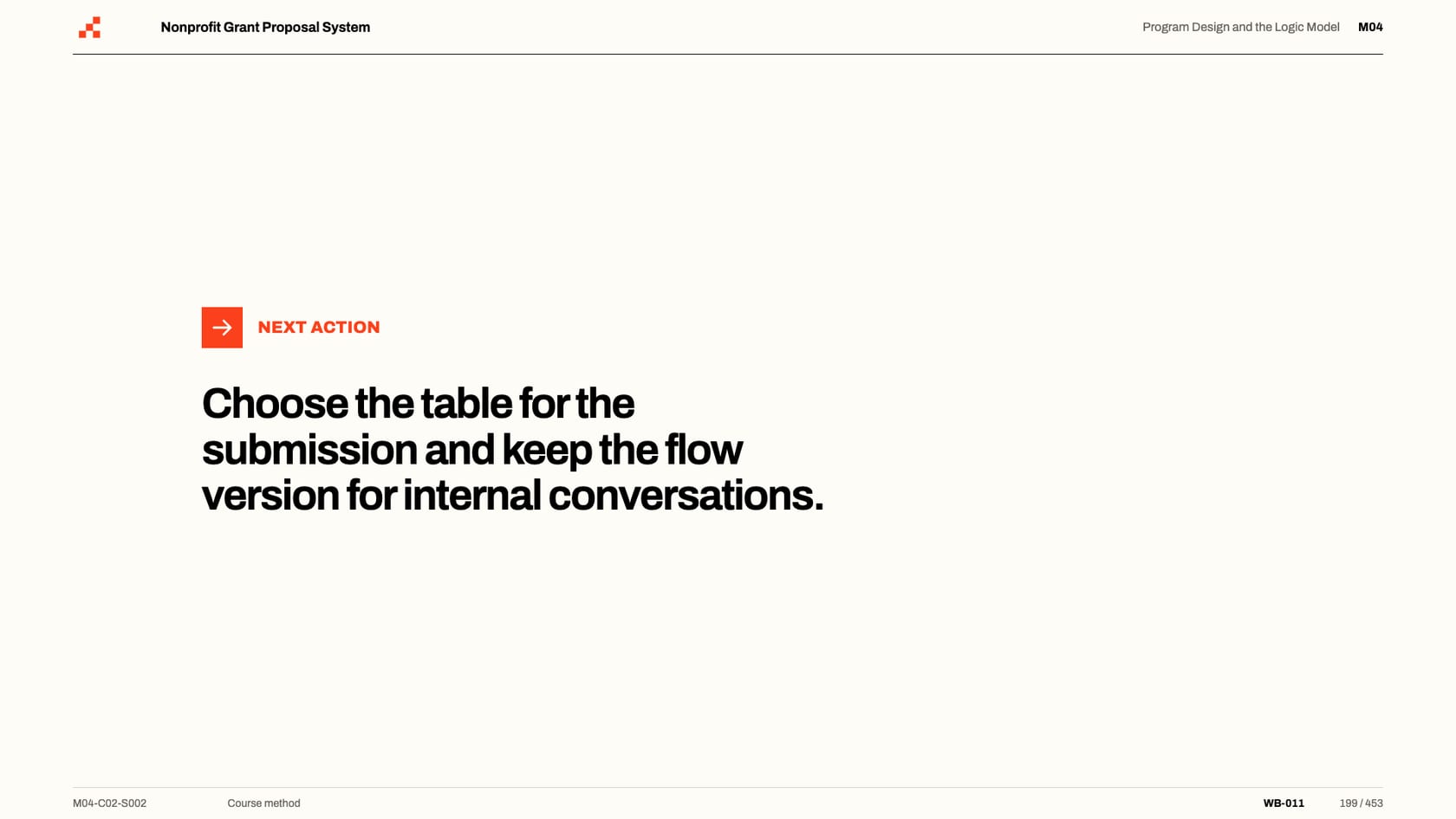
What you see is what ships: these slides are rendered from the course files themselves, not redrawn for the sales page. Sample funders and organizations are fictional and labelled as such.

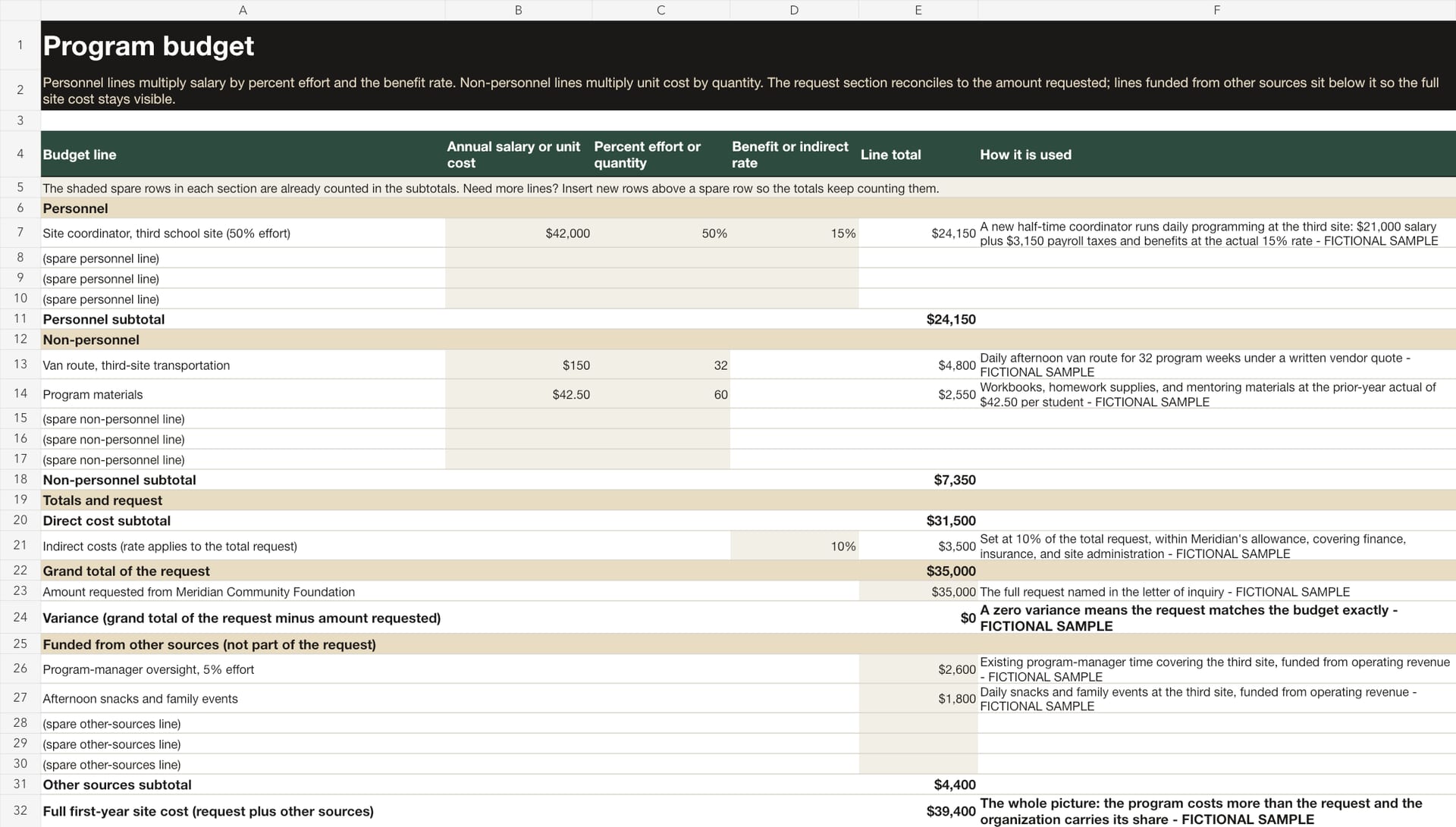
Course slide: sorting the Cedar Bend program into a logic modelThe editable budget spreadsheet with live formulasCourse slide: scoring funder fit on five weighted questionsCourse slide: compressing the system into a letter of inquiryCourse slide: building the program budget with honest personnel mathThe Cedar Bend worked demonstration, annotated end to endThe budget module opener from the coursebook

Course slide: sorting the Cedar Bend program into a logic model

01 / 07

The curriculum.

Eight modules, about 5.5 guided hours plus 4.5 to 8 applied hours. Every module ends with a component of the final pack, so by the last module the proposal system is not homework waiting to start; it is already built.

  1. Module 1 · 40 min guided · 20 to 35 minutes applied

    Orientation and the proposal system

    Explain how foundation grant decisions are made, map the twelve-part proposal system, and assemble the organization fact base.

    1. 1.1How grant decisions actually work
    2. 1.2The proposal system, not the single proposal
    3. 1.3Your organization fact base

    You leave with

    A readiness record, the proposal system inventory, and a verified organization fact base.

  2. Module 2 · 42 min guided · 30 to 50 minutes applied

    Funder fit and eligibility

    Research funders from public evidence, complete the eligibility matrix, and select a scored funder shortlist.

    1. 2.1Where grant money actually lives
    2. 2.2Reading a funder like a reviewer
    3. 2.3The funder-fit scorecard and shortlist

    You leave with

    A funder landscape scan, a completed eligibility matrix, and a scored shortlist with a first target.

  3. Module 3 · 42 min guided · 35 to 60 minutes applied

    The needs statement

    Define the community problem, log trusted evidence, and draft a problem-centered needs statement.

    1. 3.1The problem, not the organization
    2. 3.2Evidence that funders trust
    3. 3.3Drafting the needs statement

    You leave with

    A scoped problem definition, a claim-by-claim evidence-source log, and a one-page needs statement draft.

  4. Module 4 · 42 min guided · 35 to 60 minutes applied

    Program design and the logic model

    Sort the program into a logic model and write the program description a reviewer can follow.

    1. 4.1From need to program logic
    2. 4.2Building the logic model
    3. 4.3The program description

    You leave with

    A sorted program logic draft, a one-page logic model, and the program description.

  5. Module 5 · 40 min guided · 30 to 50 minutes applied

    The evaluation plan

    Choose honest indicators and assemble an evaluation plan sized for a small organization.

    1. 5.1What funders mean by evaluation
    2. 5.2Indicators and measurement
    3. 5.3Writing the evaluation plan

    You leave with

    An evaluation scope decision, a fully specified indicator table, and a one-page evaluation plan.

  6. Module 6 · 42 min guided · 40 to 70 minutes applied

    The budget and budget narrative

    Build the program budget with clean personnel math and a budget narrative that matches the program.

    1. 6.1The budget tells the truth
    2. 6.2Building the program budget
    3. 6.3The budget narrative and sustainability

    You leave with

    A budget frame, the completed program budget, and the budget narrative with a sustainability answer.

  7. Module 7 · 42 min guided · 40 to 70 minutes applied

    Core narrative and letter of inquiry

    Draft the reusable core narrative bank, the letter of inquiry, and the AI-assisted drafting protocol.

    1. 7.1The reusable core narrative
    2. 7.2The letter of inquiry
    3. 7.3AI-assisted drafting with verification

    You leave with

    The six-paragraph core narrative bank, a letter of inquiry sized to the funder's stated length, and the drafting protocol.

  8. Module 8 · 42 min guided · 40 to 70 minutes applied

    Assembly, review and submission

    Assemble the proposal pack, pass compliance, self-score against the reviewer rubric, and run the submission and reuse workflow.

    1. 8.1Assembly and the reviewer rubric
    2. 8.2Compliance and submission
    3. 8.3After submission and the reuse system

    You leave with

    The assembled, self-scored proposal, a passed compliance checklist, a live submission tracker, and the reuse calendar.

The honest boundary

What this course refuses to promise.

  • Guaranteed awards
  • Funder introductions
  • A template that wins by itself
  • Writing done for you

What you get instead: a complete, honest, professionally assembled request, and a workflow that produces the next one faster. Wherever a funder's current guidelines differ from the course, the funder's guidelines govern.

The budget tells the truth. Every claim earns its evidence.

Read it before you buy.

Quoted word for word from the editable toolkit, so you can judge the writing standard before you pay for it. Nothing is paraphrased.

Tailoring changes emphasis and vocabulary around unchanged facts. Shipping the frame unchanged is boilerplate; changing the facts is dishonesty. Neither belongs in a funder document.

Bank rule

Core narrative bank template, in the editable toolkit

Reframe the problem toward the funder’s stated priority without changing the evidence: the same waitlist can evidence an education gap, a safety gap, or an equity gap depending on which is true and which the funder names.

Tailoring note, need summary

Core narrative bank template, in the editable toolkit

The rubric’s job is to generate the repair list, not a grade to feel good about.

Assemble and self-score

Submission runbook, in the editable toolkit

Questions, answered.

  • I have never written a grant. Is this too advanced?

    No. The course assumes no grant experience. You need working knowledge of one nonprofit (its mission, programs, people and rough budget) plus a word processor and a spreadsheet. Everything else is taught.

  • Is this about federal grants?

    The core system targets foundation and private grants, where most small organizations actually start. The Advanced Toolkit adds a bounded federal-readiness path: registration checklist, government budget differences, and when federal is worth pursuing at all.

  • What exactly do I download?

    The Professional edition ships 25 files: the 96-page coursebook, the full presentation edition bookmarked by module, the 24-page workbook and 12-page toolkit in A4 and US Letter, every editable template including the 10-sheet budget spreadsheet, three annotated worked demonstrations, the guides and the dated source list.

  • Can I use it for client work as a freelance grant writer?

    Yes. The license covers your own organization and client work if you adapt the system as a consultant; the Advanced Toolkit includes a chapter on running it as a freelancer. Reselling or republishing the materials themselves is not permitted.

  • Does it promise I will win grants?

    No, and be suspicious of anything that does. Funder decisions belong to funders. The course promises the part you control: a complete, honest, professionally assembled request, and a workflow that produces the next one faster.

  • How do I know it fits my organization before I buy?

    The full curriculum, every deliverable and unedited slides from the course are on this page, and the free grant-writing articles on this site show the method's standard at article length before you spend anything. If a question is still open, write to hello@thedigitalkit.co and a human answers before you buy.

Your next application starts from a system.

From $119. Build the pack once for your organization, then reuse it for every funder on your shortlist.

Secure checkout by Lemon Squeezy. Instant digital delivery. One-time payment, files you keep.

Questions before buying? Write to hello@thedigitalkit.co and a human answers.

Still deciding? Read the grant writing library first

Get the next system first.

One email when a new course ships, with founding pricing reserved for the list. Occasional working notes worth reading. Nothing else.

Privacy choices

Choose what you are comfortable sharing. You can change this any time from “Privacy choices” in the footer. Read our privacy policy.

Required

Keeps checkout and security working, and remembers your choice.

Always on